WHAT IF DRAWING WERE A DELICATELY BRAIDED ROPE OF ANGER, LOVE, AND DESIRE THAT BINDS US TO THE WORLD?
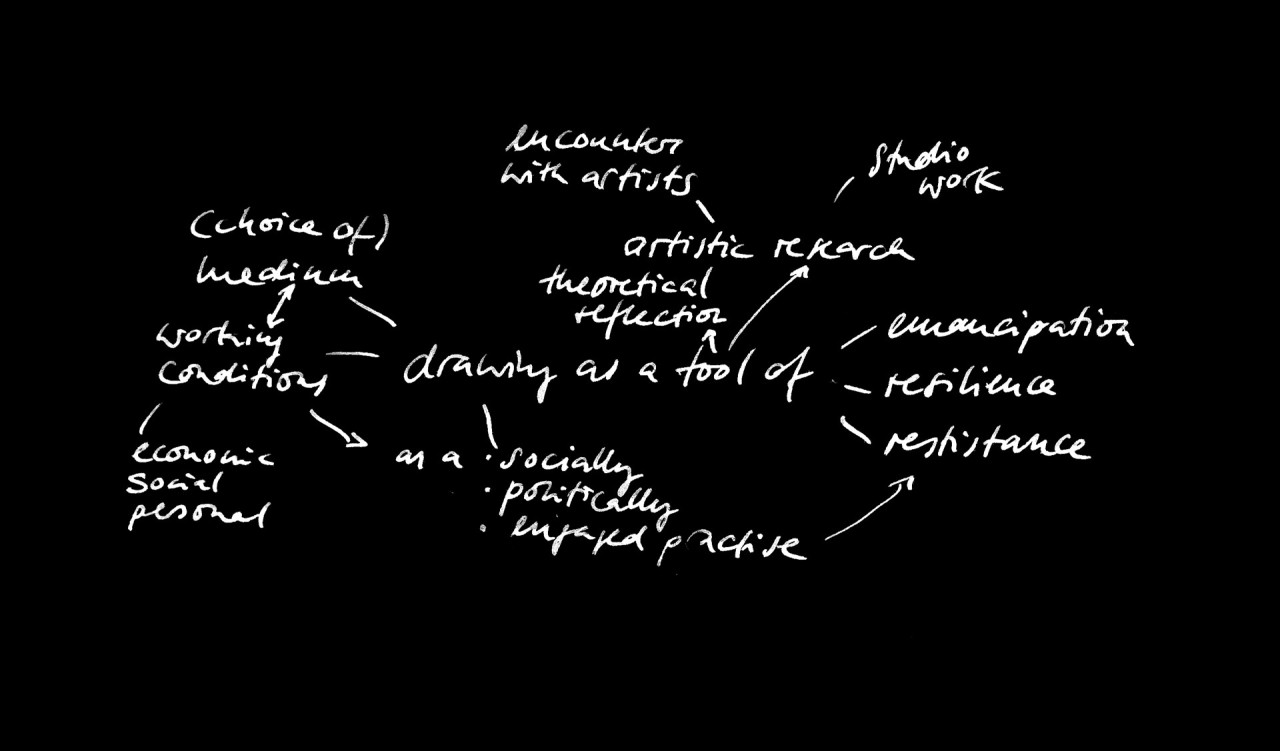
Since 2021, Katrin Ströbel has been developing a research project that explores contemporary drawing as a tool of emancipation, resilience, and resistance. At its core lies an inquiry into the role of drawing in grounding artistic practice socially and personally—particularly in times of economic and political crisis. The project brings together theoretical reflection and artistic research, nourished by studio work, the development of a body of drawings and installations, and ongoing exchanges with fellow artists.
While contemporary drawing and political art are rarely associated in current discourse—and are sometimes even seen as oppositional—they are, in practice, closely intertwined in the work of many artists. Yet few exhibitions, publications, or archives have addressed these connections, especially regarding the deliberate use of drawing as a preferred medium by women artists, queer artists, exiled practitioners, or those from diasporic contexts. This project seeks to address this gap and to shed light on these dynamics.
The artist’s focus is on socially and politically engaged practices, with particular attention to drawing. The exchanges conducted as part of the project—accompanied by drawings—open up a range of questions: What relationships emerge between drawing and sociopolitical themes? Is the choice of this medium shaped by conditions such as precarity, limited space, or care work? Is drawing particularly favored by artists in exile or within diasporic communities? And might it serve as a more accessible and democratic entry point into the art world?
For this project, Katrin Ströbel has intentionally invited artists with diverse backgrounds and biographies, at different stages of their lives and careers, who actively contribute to the research. By opening up a largely unexplored field of inquiry, the project makes an important contribution to the discourse on contemporary drawing in a world shaped by crisis.
This long-term research will be made visible and accessible in various forms such as exhibition projects, talks and a series of editions published by Roven editions, Paris, accompagnied by Johana Carrier, Pia-Melissa Laroche and Sarah Netter. The publications and exhibition formats seek to demonstrate how, in times of social tension, increasing precarity, and economic and political violence, the space of drawing becomes a space of resistance.
DRAWING AS A SOCIAL GESTURE
Developments in Drawing Theory and Practice through the Lens of Ethnicity, Class, and Gender
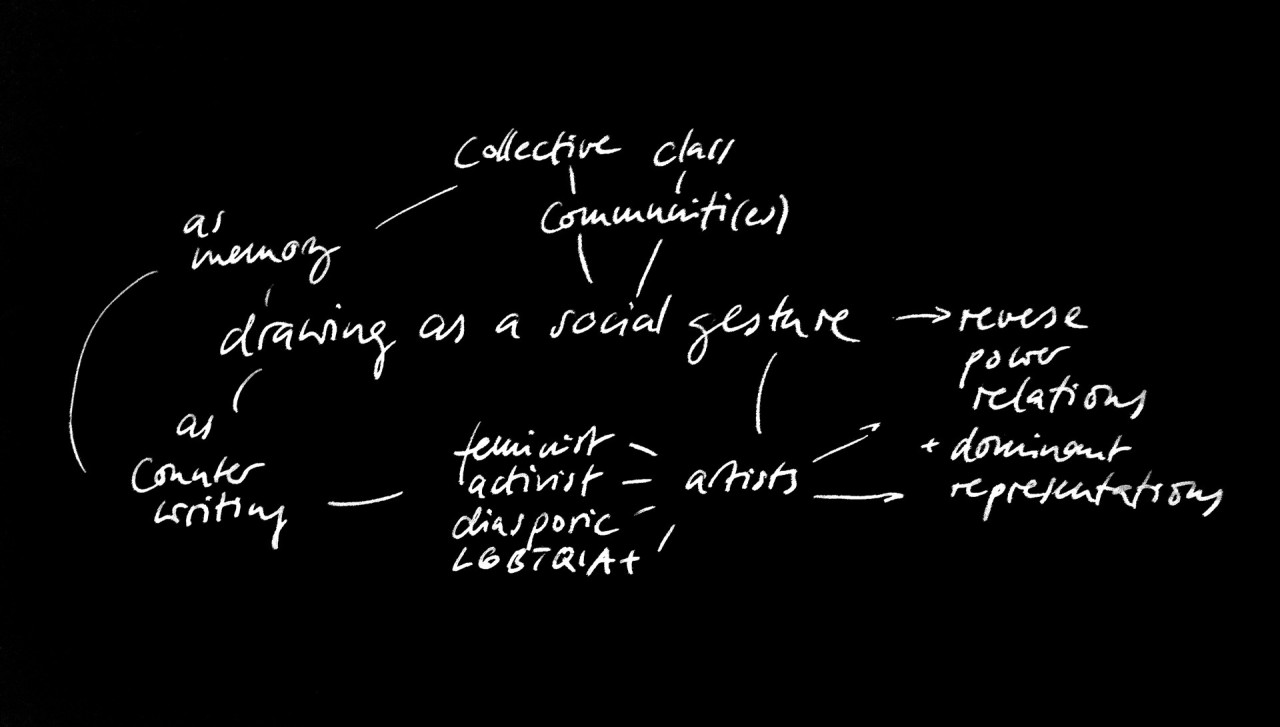
Drawing as a social gesture is a collaborative research project by art historian Marine Schütz and artist and researcher Katrin Ströbel.For about twenty years, the uses of drawing have shown that this medium allows us “to reflect on the world and to engage actively with it” (Rebecca Fortnum, 2021). Capable of provoking change—beginning with the way artists choose to respond to their experience and environment—this familiar and lightweight medium, open both to visual technologies and to thought, is increasingly being used as a catalyst in collective forms of action. When combined with images, it also helps to accompany social and political transformations through its ability to challenge dominant representational politics, in terms of ethnicity, gender, and class.
While such approaches emerged in the 1960s, apart from a few texts by Benjamin Buchloh and Karen Kurczynski—who interpreted the critical potential of drawing by pointing to its form of material resistance—the recognition of its critical power remains incomplete. Among the conditions that have led artists to experiment with drawing as a social gesture, we must certainly include the evolution of drawing pedagogy. By setting aside technical normativity, these new approaches have opened the field to identity politics and visual cultures. The acknowledgment of drawing’s own resources—its “indeterminacy” (Karen Kurczynski, 2014) and its “relational dimension” (Ed Krma, 2010)—also seems to explain the growing presence of social questions in drawing, whose boundaries are increasingly porous, as its gestures and spaces overlap with those of performance or installation.
This project aims to explore the relationships between drawing and the social field, through artists’ voices and actions as well as researchers’ case studies. Presentations of the first two colloquium helped to identify the ways in which artists can—and have—used graphic practices to reverse the power relations implied by social normativity and dominant representations. Some contributions explored the singular functions that emerge from drawing as memory or counter-writing, revealing how these uses are shaped by specific subjective positions—particularly LGBTQIA+, diasporic, feminist, or activist. Others examined drawing as a social gesture, interpreting the nature of this intersection through the evolution of definitions of the graphic act, bearing witness to the challenge posed to its classical conditions when it becomes collective.
Historically, drawing has been the site of extensive theorization. The symposium therefore seeks to question how this legacy evolves and renews itself in the era of postcolonial, feminist, and cultural studies. Indeed, these fields make it possible to grasp issues of power and domination related to the “matrix of gender, race, and class” (Hall, 1996). They offer tools to understand how subjects can, through their very positions of enunciation, transform the social world—either directly or by reshaping the balance of power that they assert, destabilizing—through drawing—the established politics of representation.
The first colloquium conceived by Katrin Ströbel and Marine Schütz took place in December 2024 at the State Academy of Art and Design in Stuttgart, Germany. The second edition of Drawing as a social gesture continues the initial research and seeks to enrich the debates prompted by the turn toward drawing as a social gesture, over a long period stretching from the late 19th century to the present day, and informing contemporary art. It will draw upon the resources held by the Frac Picardie, within the framework of a partnership established between this institution and the UFR des Arts, by bringing together the contributions of researchers, museum professionals, and local, national, and international artists.
SITUATIONS POST
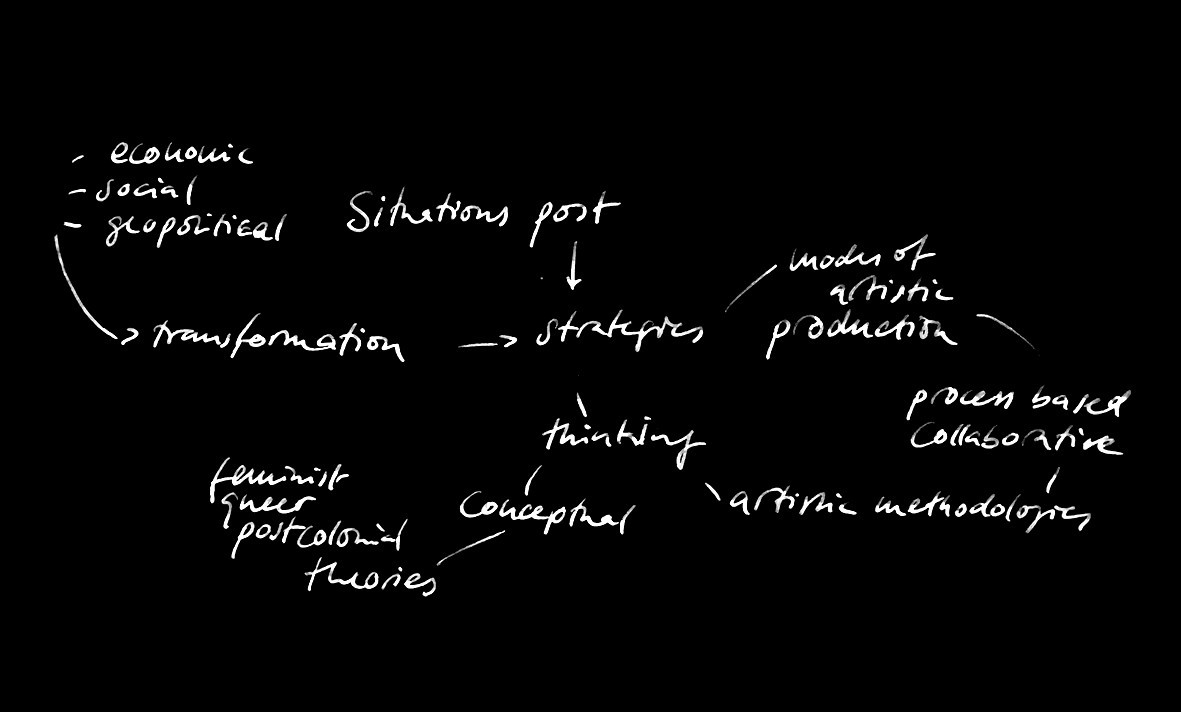
Situations post (2014–2024) is a research unit in artistic and theoretical practices directed by Katrin Ströbel and Sophie Orlando at Villa Arson, Nice, France. It takes as its point of departure the ways in which the geopolitical, economic, and social transformations initiated in 2007 have prompted a reconfiguration and renewal of artistic strategies. The unit is grounded in an intersectional framework that considers race, social milieu, gender, and sexuality as formal materials mobilized within a critical, political, and social present.
The analysis of contexts—understood as labor economies, networks, publics, modes of production, strategies, tools, and resources—together with feminist, queer, and postcolonial theories, is pursued both artistically and conceptually. These frameworks are not approached as a history of representation, nor as illustration or documentation of historical moments, but rather as a history of forms situated within specific artistic and intellectual lineages.
The workshop integrates research, analysis, and practice, with particular attention to process-based modes of artistic production and collaborative methodologies. It aims to develop a critical reflection on the relationship between situated knowledge and space, including the space of writing and notation, the space of production conceived as exhibition space, and the spaces of the archive and the document.
The unit draws in particular on Donna Haraway’s theory of situated knowledges; Stuart Hall’s concept of “new ethnicities”; intersectionality and Black feminist epistemology as articulated by Patricia Hill Collins; Sam Bourcier’s work on queer sex politics; and Sara Ahmed’s queer phenomenology.
Ants walk two ways, a collective publication resulting from the research project led by Sophie Orlando and Katrin Ströbel takes as its starting point the way in which current geopolitical, economic and social changes induce a renewal and adjustment of artistic strategies, by investing, in an intersectional perspective, contextual thinking and feminist, queer and postcolonial thinking in an artistic and conceptual way.
CRITICAL FACULTIES
BiPoC+ FLINTA* at Art Academies
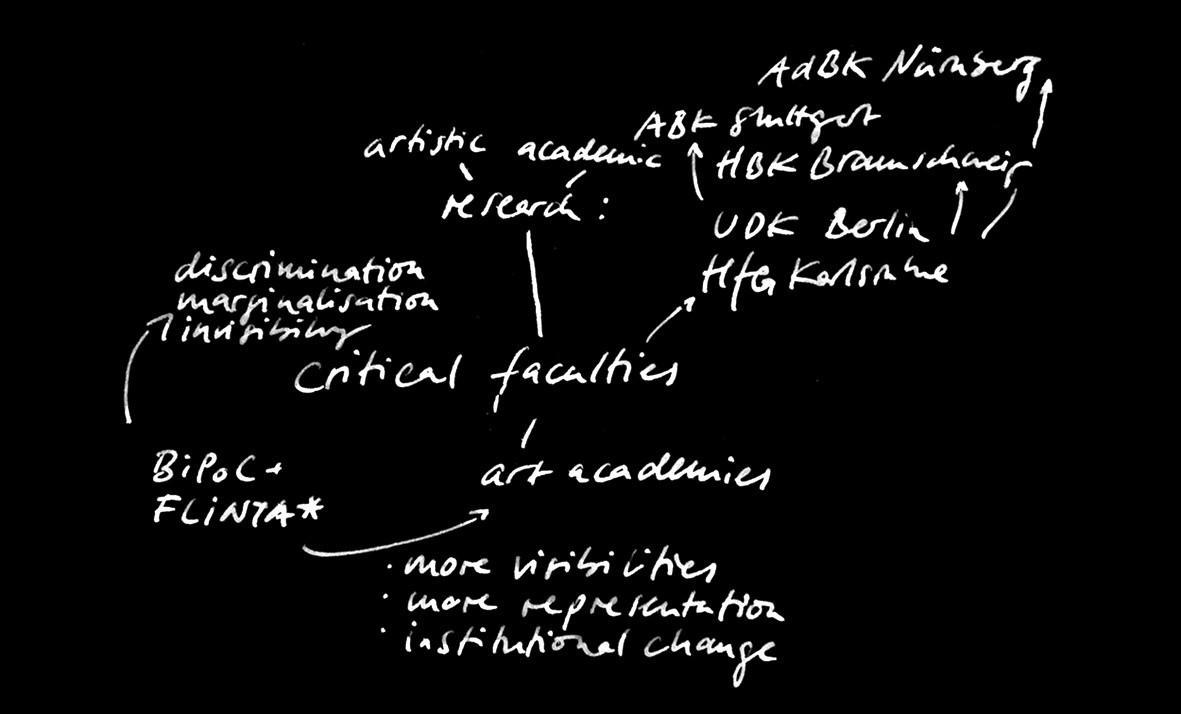
The joint project Critical Faculties. BiPoC+ FLINTA at art academies is simultaneously investigating structural obstacles to BiPoC+ FLINTA at art academies and mechanisms that impede the visibility of BiPoC+ FLINTA and its achievements in the fields of fine arts, art sciences and science at the HfG Karlsruhe and UdK Berlin. BiPoC+ FLINTA refers to all people who see themselves as women, lesbians, trans*, inter, non-binary or genderqueer and who experience racist and/or anti-Semitic discrimination in Germany due to their (ascribed) origin, religion, language or appearance. The aim is to develop practical recommendations for action for more visibility, representation and institutional change.
The project combines artistic and academic research. The scientific survey with a focus on racism, inequality and higher education research is supervised by Prof. Ulaş Aktaş and staff at the UdK Berlin. The aim is to use the research findings to develop practical recommendations for reducing and overcoming these obstacles. The effectiveness of these recommendations for action will be tested through scientifically supported participatory practical research. The artistic research is based at the HfG Karlsruhe in the Department of Media Art and is being carried out as a model project in cooperation with the ABK Stuttgart, the AdBK Nuremberg and the HBK Braunschweig. The interdisciplinary core concept group - the LAB - brings together well-known experts from art and science, including Prof. Diana McCarty, Ülkü Süngün and Anna Feldbein (HfG Karlsruhe), Prof. Heba Amin, Prof. Lucienne Roberts, Prof. Katrin Ströbel and Carmen Westermeier (ABK Stuttgart), Prof. Anike Joyce Sadiq (AdBK Nuremberg) and Prof. Havîn Al-Sîndy (HBK Braunschweig). The starting point of the artistic research are questions on knowledge production and archives, decolonization of algorithms, the art canon in teaching, visual codes and visibility politics in art, drawing as a political gesture, as well as self-institutionalization as an artistic-political strategy.
The results of the interdisciplinary research process will be presented at an international symposium and an exhibition in Karlsruhe in 2027. The documentation will take the form of a bilingual open access publication and project website.
Ülkü Süngün, initiated, conceived and applied for the research project with the HfG Karlsruhe. She works as a sculptor, curator and research activist as well as teaching and lives in Stuttgart. She studied at the State Academy of Fine Arts Stuttgart, where she last taught as a substitute professor from 2022 to 2023. In 2017, she founded the “Institute for Artistic Post-Migration Research” as a nomadic art project, from which the current research project developed. Ülkü Süngün's artistic practice combines art with socio-critical questions in the context of migration as well as memory and identity politics in the immigration society.
The research project is funded by the Federal Ministry of Research, Technology and Space (BMFTR) under the funding code 01FP24094 ”Verbundvorhaben BiPoC Frauen an Kunstakademien im Fokus - die diskriminierungsfreie Akademie“ as part of the funding line ”Innovative Frauen im Fokus" (IFIF).
TEXT & IMAGE
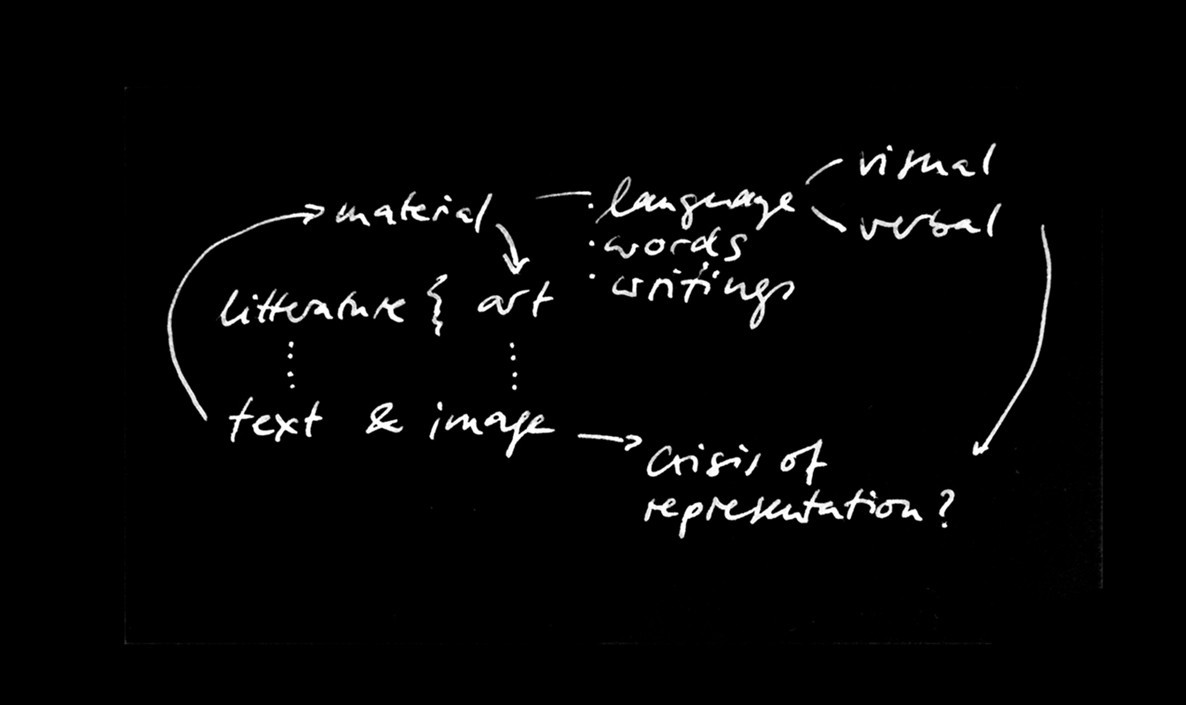
Why do artists incorporate words, writing and text into their works? In her PhD research project on the relationship between text and image in contemporary art, Katrin Ströbel offers compelling answers to this question. Today, it no longer surprises us when artists integrate entire messages into their works. Language—like form and color—has become an everyday material of visual art. But how did language find its way into art? And how is it being used by artists today?
Ströbel explores these questions in depth in her comprehensive study. As both a visual artist and a researcher, she examines a phenomenon that has been evolving for over a century with clarity and precision. She devotes significant attention to contemporary works that employ writing in diverse and often innovative ways. As a result, her research increasingly reads as an engaged—though intellectually demanding—introduction to contemporary art.
Through numerous examples, Ströbel demonstrates that although artists incorporate language—alongside other elements drawn from social and cultural life—into their works, they do so in the service of visual art. Text conveys meaning, tells stories, or at least creates references—an inexhaustible reservoir of material for artistic practice. Yet even as the exchanges between art and literature grow more sophisticated, artists continue to operate from a perspective distinct from that of writers. Writing does not replace the image—it complements it.
PAPER IS (IM)PATIENT
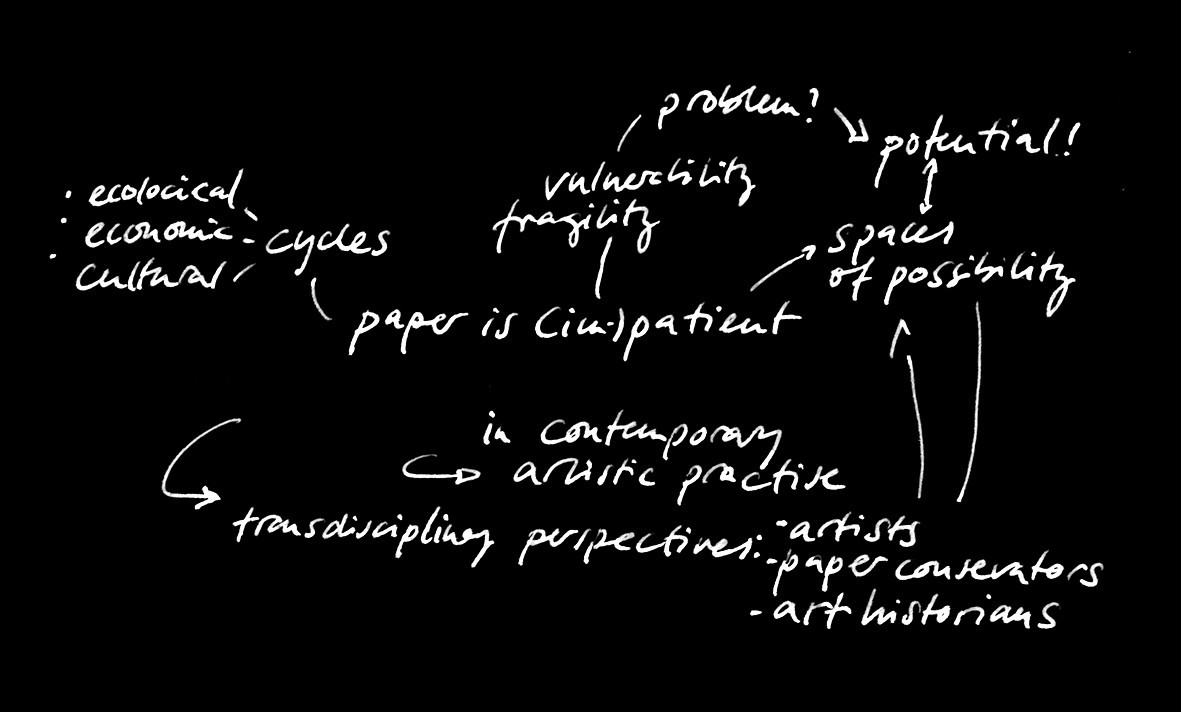
Paper is (im)patient engages with paper within the context of contemporary artistic practice and examines its materiality from multiple perspectives. The fragility and vulnerability of paper are not viewed merely as challenges or problems; rather, they are understood as potentials and spaces of possibility—intrinsic qualities that carry meaning in themselves.
The production and use of paper in contemporary art are embedded in ecological, economic, and cultural cycles that cannot be separated from the content of the artworks. As part of two interdisciplinary colloquia, Katrin Ströbel, Irene Brückle, and Hanna Hennenkemper, together with international guests, explored the role of art on paper in contemporary practice from three interconnected perspectives that directly influence one another in practice. They examine artistic processes in which paper plays a central material role, the museum presence and display of artworks on paper, and their conservation and restoration. At the same time, they investigate how these aspects interact and shape one another. Artists, art historians, and conservators provide insights into their work and reveal connections between their respective fields.
The two colloqua Paper is (im)patient in 2025 and 2026 thus not only offered a survey of current scholarly and artistic positions but also aims to develop shared perspectives for engaging with the relationship between contemporary art and paper.